The Claim
Standardized acupuncture points have distinctive, reproducible anatomical or biophysical properties that reliably distinguish them from nearby matched non-acupuncture sites.
Boundary: This is a claim about objective properties of point locations. It does not ask whether needling at these sites improves pain compared with sham, whether the traditional routes follow known anatomy, or whether an independent meridian network exists. Specificity of a neural response is one candidate property, but it cannot be silently equated with unique skin or histological morphology.
Where It Comes From
Acupuncture identifies named body-surface points and traditional practitioners sometimes describe them as special openings or functional sites. Researchers have attempted to detect lower electrical resistance, temperature changes, connective-tissue geometry, nerve clusters or locally specific neurophysiological reactions. Conventions associated with the World Health Organization (WHO) standardize 361 traditional point locations for research and practice; standardization is a coordinate agreement, not anatomical confirmation.
Why It Sounds Convincing
Skin conductance can be measured, nerves respond to electrical stimulation and anatomical landmarks help locate points. A grid heatmap with a dark spot at a named point looks like a discovery. But every claim of a special location depends on correct localization, matching the control skin area, instrument stability and how much variation would appear at randomly chosen sites.
The Short Answer
Researchers have reported some measurable differences at certain acupuncture points, but they have not established a unique physical feature that reliably identifies acupuncture points in general.
Electrical measurements have produced mixed results. A controlled experiment found that most tested points did not consistently differ from nearby skin. Animal research does show that stimulating some body regions and tissue depths can activate different nerve pathways. That is an important physiological result, but not proof that every named point is a unique anatomical structure.
The overall claim remains Inconclusive.
How It Would Have to Work
Choose points from a prespecified anatomical atlas and matched control sites away from the named points but similar in sweat glands, skin thickness, temperature and nerve/vessel density. Blind the operators to site labels. Predefine a measure, tolerance and clinically or anatomically relevant discriminative threshold; report sensitivity, specificity, intra- and inter-operator reliability, time stability, negative controls and external replication. A distinct property should predict point identity in held-out participants, not merely produce a statistically selected difference in a few readings.
What Actually Happens
Electrical impedance is sensitive to skin moisture, stratum corneum, electrode area and pressure, contact duration, angle and local surface anatomy. Fascial and nerve structures can make a region respond differently to stimulation without forming a unique histological ‘acupoint organ.’ Two locations can show different physiology because they contact different nerves, even when the traditional names are irrelevant to the mechanism.
What the Evidence Shows
Can an electrical instrument find an acupuncture point?
Some researchers have proposed that acupuncture points should have unusually low electrical resistance compared with surrounding skin. That makes the claim testable: measure specified points and nearby comparison locations under the same conditions.
An early review found several studies reporting lower resistance at selected points or meridians. But many experiments were small, poorly controlled or difficult to reproduce. The review could not establish a dependable method for electrically identifying acupuncture points.
What happened in carefully controlled comparisons?
In a 2007 experiment, investigators selected several named acupuncture points and nearby comparison sites, then measured electrical resistance with two different instruments. The points were not consistently different from the controls. The researchers also observed that repeated contact could change readings.
That does not exclude a very small local feature that their instruments might have missed. It does mean the study did not find a generally reliable electrical signature at the tested points.
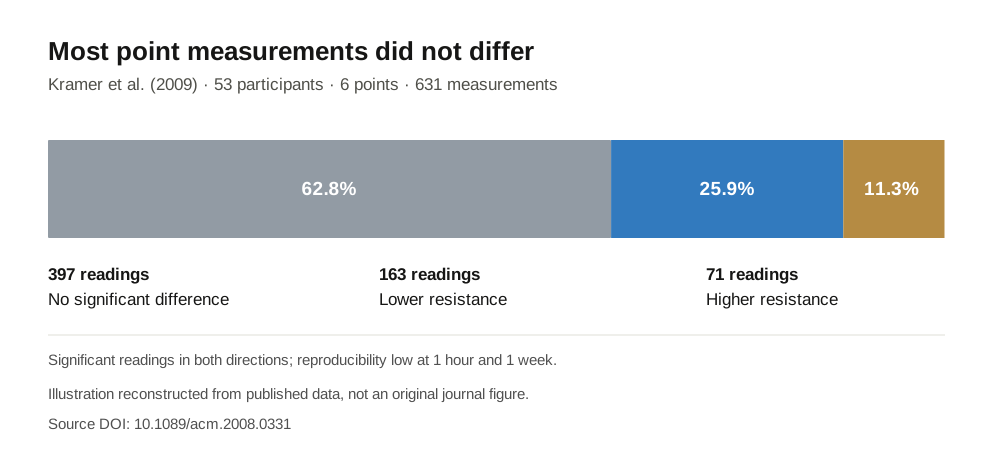
Another team used a grid of small electrodes in 2009 to map the skin around six named acupuncture points. Most readings showed no clear difference between the designated point and surrounding locations. When differences appeared, some points had lower resistance, while others had higher resistance. The pattern was also less stable over longer periods.
This is important because a usable physical “fingerprint” should be reproducible and distinguish the named point from ordinary skin in a consistent direction, not change unpredictably across locations and repeated measurements.
Does anatomy offer a different explanation?
A 2021 mouse experiment published in Nature found that stimulating particular regions and depths of tissue could activate a specific neural pathway, while stimulation elsewhere did not produce the same response. Researchers tested the involvement of identifiable sensory neurons.
That provides real evidence that where and how the body is stimulated can matter biologically. It does not demonstrate that every traditional acupuncture point has a unique measurable structure or that the traditional meridian system has been anatomically verified.
Why does agreement on point location matter?
Before measuring an allegedly special site, researchers must know precisely where it is. Reviews have found that trained practitioners do not always locate the same traditional point in precisely the same place. International standards make descriptions more consistent, but agreeing on a location is not evidence of a unique physical property.
What can we conclude?
A few specific body regions may respond differently to stimulation, and some positive electrical findings warrant better studies. But there is no established universal electrical or anatomical signature that reliably distinguishes the entire system of acupuncture points from neighboring tissue.
The Strongest Evidence for the Claim
Some controlled electrical studies have reported differences at selected acupuncture points. More persuasively for site-specific physiology, experimental mouse research found that stimulating particular tissues engages different neural pathways.
These results leave open the possibility of distinctive properties at some sites. They do not prove that all named acupuncture points share one independently identifiable physical feature.
The Strongest Evidence Against It
Controlled electrical studies have often failed to identify a consistent difference between named points and nearby skin. In a detailed electrode-grid experiment, most locations were not distinguishable, and differences that did appear went in both directions.
Measurement conditions and disagreement over exact point locations can also affect results. These are strong reasons to doubt a simple universal electrical “point detector,” although they do not exclude all local anatomical differences.
Common Viral Arguments
‘Electrodermal devices always locate acupuncture points.’ The measurement may be real, but reliability and discriminative accuracy have not been established by the cited experiments.
‘A specific response at ST36 proves 361 special points.’ One experimental mouse reflex cannot validate every human atlas location, every condition or the proposed meridian routes.
‘WHO recognizes 361 points, so WHO verified their anatomy.’ A standard for naming and location is not empirical evidence of their anatomical distinctiveness.
The Reasoning Error
Overgeneralization takes a result from some points or one stimulation reflex and applies it to the full atlas. Surrogate-endpoint error treats temporary skin resistance or a nervous-system response as proof of a specific traditional anatomy and route mechanism. A sound analysis accepts observations without overextending them.
What Would Change Our Conclusion?
Multi-laboratory blinded, preregistered studies that repeatedly distinguish named points from strong matched controls with meaningful classification performance and sustained reliability would raise confidence. Conversely, sufficiently powered, carefully controlled repeated negative studies across point types and populations would strengthen an Unsupported verdict. Anatomical specificity and clinical benefit must each be tested separately.
Evidence Status
Status: Inconclusive
Evidence quality: Low
Positive and negative observations exist but do not amount to a consistent general biological signature for acupuncture points. Local responses to stimulation are plausible and in some animal settings experimentally demonstrated; this is not the same Claim.
Evidence & Sources
The structured Evidence records link to the original electrical comparisons, the broader methods reviews, point-location research and the 2021 mouse nerve-pathway experiment.
These sources ask related but different questions: whether skin conductivity differs, whether two people identify the same location, and whether stimulation at a particular tissue site engages a distinct neural response. A positive result in one area does not automatically settle the others.
Corrections & Updates
First published October 8, 2026. No post-publication corrections recorded.
Last Reviewed
October 8, 2026.