The Claim
Traditional acupuncture meridian routes correspond to identifiable fascial, neural or related anatomical structures more consistently than appropriately matched control routes.
This Investigation tests map correspondence, not the existence of a novel meridian system or whether acupuncture treats pain. The separate Investigations assess whether meridians form a new anatomical network and whether individual points have distinctive measurable properties. The distinction matters: an overlap with ordinary fascia can be real without providing a new organ system or validating the theory of qi.
Where It Comes From
Traditional East Asian acupuncture identifies routes joining named acupuncture points and associated conceptually with organs and qi. Modern anatomical investigators have sought conventional substrates for these routes, proposing fascial planes, sensory nerve distributions, connective-tissue boundaries, neurovascular bundles and a proposed primo vascular system. These candidates are not interchangeable: one predicts planes, another nerves, another independent vessel-like structures.
The evidence considered here tests what is mapped and how accurately; traditional meridian diagrams document the model to be tested, not proof of its anatomical correctness.
Why It Sounds Convincing
There are genuine fascial layers and nerve paths in the human body. A needle can engage skin, connective tissue and sensory endings. An overlap shown on a photograph or dissection is visually striking, especially when the original map precedes modern tissue imaging. The central question, however, is whether the specific traditional routes outperform matched alternatives, not whether human bodies contain connective tissue near acupuncture points.
The Short Answer
There are interesting observations of regional overlap. A 2002 arm study reported about 80% correspondence for selected points, and a 2019 cadaver study describes portions of fascia following certain proposed routes. But neither establishes that the traditional whole-body network maps specifically and reproducibly onto a unique conventional anatomical network. The evidence for the comparative map-correspondence claim remains inconclusive and low-quality.
How It Would Have to Work
A prospective map test needs (1) a frozen historical or standardized meridian map with tolerances, (2) a predeclared anatomy modality and definition of a fascial/nerve feature, (3) blinded examiners and prespecified matching rules, (4) matched non-meridian routes controlling for region, length, landmarks and tissue density, and (5) a comparison metric with uncertainty across subjects and independent laboratories.
Without a null baseline, ‘80% of points near fascia’ may be impressive or unremarkable: fascia is extensive. Adjusting a line or match width after seeing the data could make many maps appear accurate.
What Actually Happens
Fascia is a ubiquitous three-dimensional connective-tissue network surrounding muscles, nerves and organs. Different muscles have fascial interfaces; nerves track anatomical constraints. Anatomical coincidences are therefore not independently decisive. The hypothesis that stimulation at some anatomical locations affects nerve circuits is also different from a hypothesis that an entire traditional meridian route corresponds to a special structure.
What the Evidence Shows
Anatomical experiment 1 — Langevin & Yandow (2002)
Question: Do acupuncture points and meridian tracks in selected sections of the arm correspond to connective-tissue planes?
Material and comparison: Serial gross-anatomical human arm sections, with identified meridian points/tracks and discernible fascial planes; some supportive ultrasound observations. The study’s focus is a limited anatomical region, not the full traditional network.
Observation: About 80% of sampled acupuncture points and about 50% of meridian intersections in the examined arm sections appeared to coincide with inter- or intramuscular connective-tissue planes.
Limits: This does not show 80% of all meridian lines on the entire body. It does not demonstrate qi transport. Although the authors specified a simplified chance model with P < 0.001, its assumed fascia widths and cylindrical geometry do not by themselves establish whole-body predictive specificity. Independent mapping, alternative baselines and replication matter before extending the result. The authors also tested a simplified random-location cylinder model over a 12.5 cm middle-arm region, with eight points and 28 meridian intersections. Assuming five major fascial planes each 5 mm wide around a 30 cm circumference and a 5 mm point/path width, they estimated a chance probability below 0.001 for the observed match rates. This is a real statistical null model, not just visual pattern-matching. Its weakness is external validity and assumed baseline geometry, rather than the absence of any statistical control. A prospectively matched map in new specimens is still needed. Langevin & Yandow, 2002.
Anatomical experiment 2 — Maurer et al. (2019)
Question: What tissues can be followed along selected acupuncture trajectories in human cadavers?
Material: Four cadavers and two additional lower legs; authors reported ten evaluated lower legs and examined 100 lower-leg point locations for vascular-nerve bundles (VNBs), among other gross and histological observations.
Observation: Only 2 of 100 investigated points coincided with the hypothesized vascular-nerve bundles. Some fascia and connective-tissue fibre alignments followed investigated sections. The paper also reports no consistent histological differences between sampled meridian and control tissues and no obvious difference in nerve-fibre location/density in the compared preparations.
Interpretation dispute: The authors propose fascia as a candidate substrate despite the weak VNB results. Their measured fascia is real; whether it preferentially delineates meridians over other comparable paths is a separate inference that the reported dissection does not establish by itself. The 100 point checks are not 100 independent randomized whole-body maps, and the specimen count is small. Maurer et al., 2019.
Electrical tissue experiment — Ahn et al. (2005)
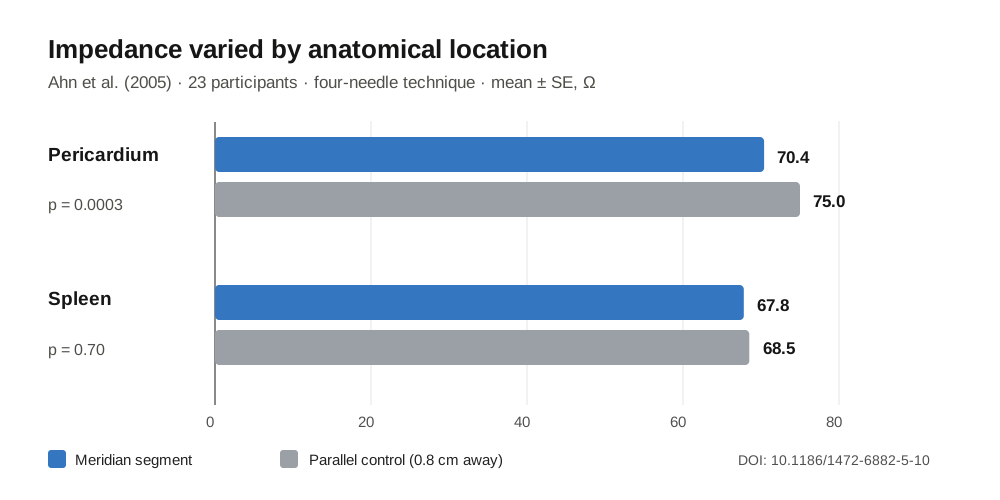
Question: Does electrical impedance differ along two prespecified meridian segments from a parallel control line 0.8 cm away?
Design: Twenty-four people enrolled and 23 completed analysis. Investigators used four gold-plated needle electrodes per line, 10 mm insertion, 3.3 kilohertz (kHz) alternating current, controlled needle spacings and ultrasound examination of underlying connective-tissue planes. The order of meridian/control testing was randomized, although the operator was not blinded to the labels.
Results: On the Pericardium segment, mean impedance was 70.4 ± 5.7 Ω versus 75.0 ± 5.9 Ω on control (mean ± standard error; p = 0.0003). On the Spleen segment, it was 67.8 ± 6.8 Ω versus 68.5 ± 7.5 Ω (p = 0.70). The same experimental setup therefore generated one significant regional result and one null result.
Critical limitation: The control needles in the arm generally entered muscle, whereas the active segment aligned with a connective-tissue interface. The investigators explicitly said that further tests were required to distinguish fascia in general from meridian-related fascia specifically. Thus it supports regional tissue-impedance variation, not proof of a distinct meridian system. Primary full-text study, Ahn et al., 2005.
Hypothesis synthesis — Bai et al. (2011)
This review proposes the fascial network as a substrate, citing anatomical reconstructions and biological plausibility. It is useful for identifying the strongest alternative to a wholly novel meridian structure. But a supportive review of heterogeneous studies does not supply a blinded, prospective, validated whole-body mapping test. Bai et al., 2011.
Proposed novel channels — primo vascular system
Claims concerning Bong-Han ducts/primo vessels sometimes appear as candidate anatomical meridians. A focused critique judged the evidence insufficient to connect those structures to the locations and functions of traditional meridians. Existence of a reported microscopic structure and identification as a traditional meridian are separate propositions. Cai et al., 2013.
Current research landscape
A January 2026 interdisciplinary review organized studies into physical (75), chemical (44) and biological (52) categories. The categorization is useful for research discovery, not a count of independent confirmatory experiments. The accessible abstract does not provide a pooled estimate for predictive route matching or a definitive anatomical validation. Cheng et al., 2026.
The Strongest Evidence for the Claim
The Langevin arm mapping figures and their model-based P < 0.001 result are the clearest positive quantitative case for regional anatomical overlap in the selected sources. Maurer’s dissection adds another empirical attempt, with positive regional connective-tissue observations. The best steelman is not ‘meridians are magical invisible tubes’, but that premodern point/route descriptions could track readily palpable or stimulus-sensitive fascial structures that medicine later described using different terminology.
That narrower idea deserves testing. It must still exceed the match-rate of reasonable control paths to establish specificity.
The Strongest Evidence Against It
Langevin and Yandow did include an explicit simplified statistical chance model, so the objection is not that no null model exists. What remains missing is prospective multi-region validation against several anatomically matched control maps across subjects. Maurer’s VNB count (2/100) directly weakens one nerve-bundle version; histological comparisons did not show a distinctive tissue identity. Fascia’s broad distribution makes uncorrected spatial overlap easier to obtain. These observations undermine a strong identity claim, but are not proof that no local correspondence whatsoever can ever exist.
Common Viral Arguments
‘Scientists found 80% overlap, so meridians exist.’ The denominator was selected arm points, not all meridians; overlap does not establish a separate structure or qi.
‘Every nerve or fascial interface is an acupoint.’ Ordinary anatomy is not specific evidence unless prespecified sites discriminate better than controls.
‘The 2019 cadaver study proved fascial meridians.’ Its authors advanced a fascia hypothesis, but also reported 2/100 VNB coincidences and non-distinct histology; both sides of their findings matter.
‘If acupuncture works, the meridian map must be correct.’ Efficacy and mechanism require different evidence and are not interchangeable.
The Reasoning Error
Overgeneralization extends findings in selected arm/leg sections to a complete body-wide traditional map. Surrogate-endpoint error treats proximity to ordinary fascia or a local physiological response as if it directly demonstrated an independent meridian system. These labels describe particular inferences; they do not invalidate the underlying physical measurements.
What Would Change Our Conclusion?
A multicentre preregistered map overlay that fixes locations, tissues, acceptable tolerance and controls before analysis, shows materially better correspondence than region-matched synthetic/control trajectories, reports effect sizes and confidence intervals, and replicates on new bodies would justify an upgrade. Several well-powered preregistered negative replications would support moving from Inconclusive toward Unsupported for the correspondence proposition.
Evidence Status
Status: Inconclusive
Evidence quality: Low
Regional correspondences have been observed, but discriminating them from dense background anatomy and demonstrating body-wide replication has not yet been achieved.
Crucially, this conclusion concerns the comparative correspondence between traditional route maps and known anatomy. It does not establish or exclude the existence of a separate physical meridian network; that is evaluated independently.
Evidence & Sources
- Langevin & Yandow (2002), primary anatomical mapping, DOI 10.1002/ar.10185. Supports regional overlap, not whole-body network identity.
- Maurer et al. (2019), primary human cadaver dissection, DOI 10.1155/2019/6976892. Mixed: apparent fascial path segments, low VNB concordance and no clear histological discrimination.
- Bai et al. (2011), supporting fascia hypothesis review, DOI 10.1155/2011/260510. Mechanism proposal, not direct independent proof.
- Cai et al. (2013), primo vascular comparison, DOI 10.1155/2013/279176. Challenges linking a proposed channel system to the meridian map.
- Ahn et al. (2005), human needle-electrode comparison, DOI 10.1186/1472-6882-5-10. Mixed regional findings: Pericardium positive, Spleen null, comparator confounded by fascia versus muscle.\n6. Cheng et al. (2026), research landscape review, DOI 10.1016/j.joim.2025.09.004. Contextualizes newer research; abstract inspected, full text not yet verified.
Source-access limitation: The full text of the 2026 review was not examined; conclusions depending on its original tables, anatomical sample-selection details or figures therefore remain unverified in this Investigation.
Corrections & Updates
October 8, 2026 — substantive scope clarification and expanded evidence review. The original October 7 article combined route-to-anatomy correspondence, the question of a separate meridian network, and measurable properties of individual points. Those are now three separately testable Investigations. This article retains the stable URL and addresses only correspondence with known anatomy. The Evidence Status remains Inconclusive and Evidence Quality remains Low. Earlier published wording remains available in version history.
Last Reviewed
October 8, 2026.